
Delegation: What It Is and How to Effectively Delegate Tasks to Your Team
2026 10 20For a manager, delegation is not a way to get rid of unpleasant tasks, but a tool that helps the team grow faster than the manager themselves. According to a Gallup study involving 143 executives from the fastest-growing private companies in the US, companies led by executives with high delegation talent grew by an average of 1,751% over three years, and their revenue was 33% higher than that of companies led by executives with poor delegation skills.
However, only one in four entrepreneurs with at least one employee has strong delegation skills. The remaining 75% do not always delegate tasks effectively, which means some tasks may end up back on the manager’s desk. Why does this happen when everyone knows that delegation is necessary?
The answer lies not in knowledge, but in practice: which tasks to delegate, whom to entrust them to based on their strengths, how to agree on boundaries, and when to stop checking. This is illustrated by concrete examples of delegation in IT, finance, and business management, the most common mistakes, and guidelines for recognizing when there is no one left to delegate to and it is time to hire a new specialist.
What Is Delegation and What Does It Mean for a Manager?
Delegation is the transfer of a task, authority, and responsibility for its execution to an employee, while ultimate accountability for the outcome remains with the manager. The employee is given the authority to make decisions within their area of responsibility, while the manager remains accountable to the owners or board for the overall results.
This is what distinguishes delegation from simple task assignment, where only the task is assigned without granting decision-making authority. The legal meaning of the term – delegating individuals to EU institutions – is unrelated to a manager’s work.
The transfer of authority is precisely what can determine success. Assigning a task without granting decision-making authority is one of the most common reasons for failure: the employee still has to get the manager’s approval at every step, and the manager ends up saving no time.
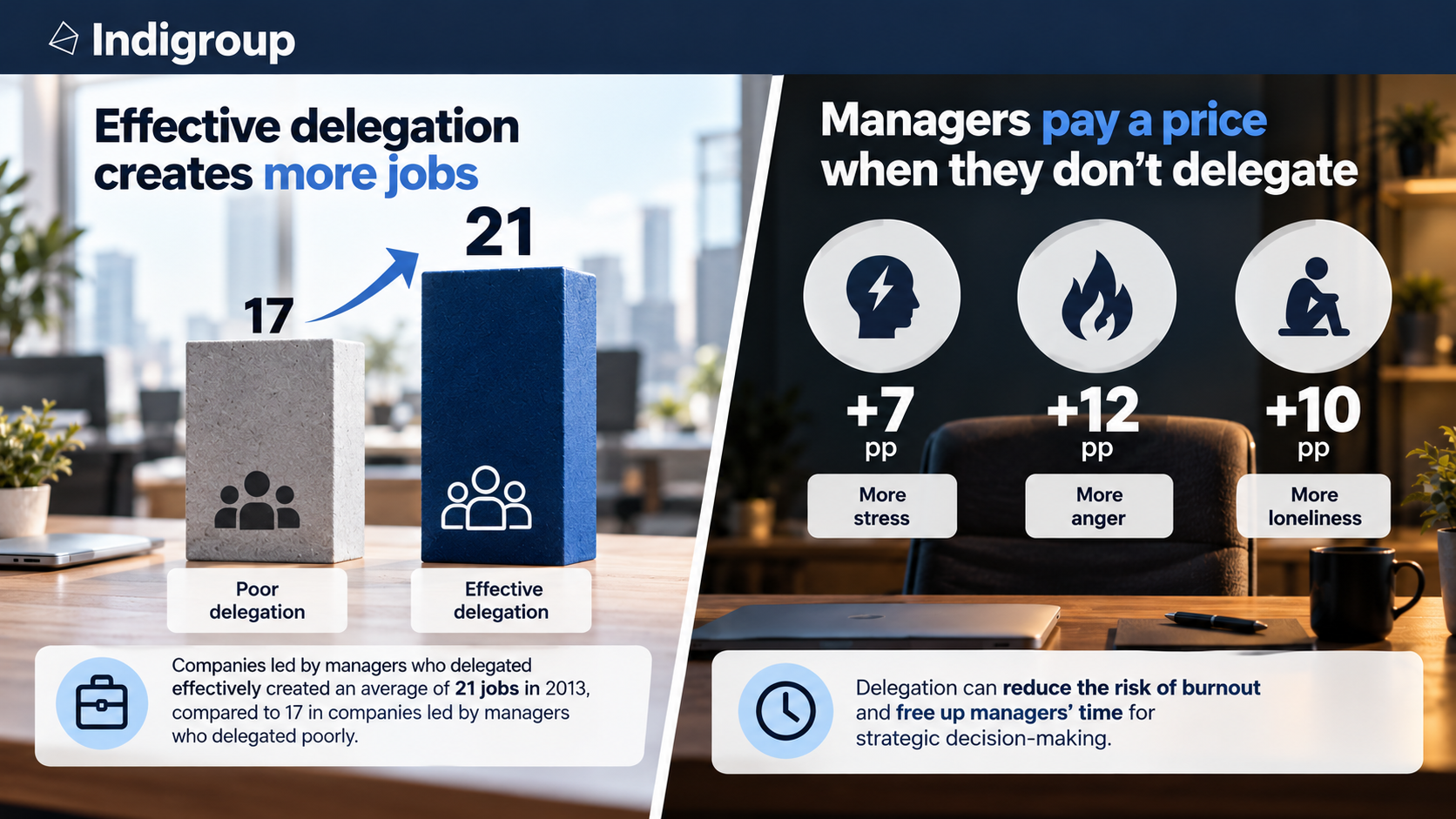
The figures show how much this can cost. According to the same Gallup study (Badal, Ott, Gallup Business Journal, 2015), companies led by managers who delegated effectively created an average of 21 jobs in 2013, compared to 17 in companies led by managers who delegated poorly. The manager also pays a price.
Compared to individual contributors, managers are more likely to experience stress (+7 percentage points), anger (+12), and loneliness (+10) (Gallup, State of the Global Workplace 2026). Delegation can reduce the risk of burnout and free up managers’ time for strategic decision-making.
How Can Managers Effectively Delegate Tasks to Their Teams?
Effective task delegation can take place in four stages: the manager selects the right task, chooses the right person based on their strengths, agrees on the expected outcome and the limits of their authority, and then maintains regular feedback without micromanaging.
When should you start? According to a Gallup study (Jim Harter, 2026, 16,442 managers), managers who spend up to 40% of their time on individual work maintain above-average team engagement. When this threshold is exceeded, engagement may decline, reaching just 32% in teams with 25 or more direct reports. Therefore, 40% can serve as a practical benchmark: if individual contributor tasks take up more time, it is worth considering delegating them.
Routine and repetitive tasks, tasks that align with a team member’s strengths, and tasks that provide employees with opportunities for growth are the most suitable for delegation.
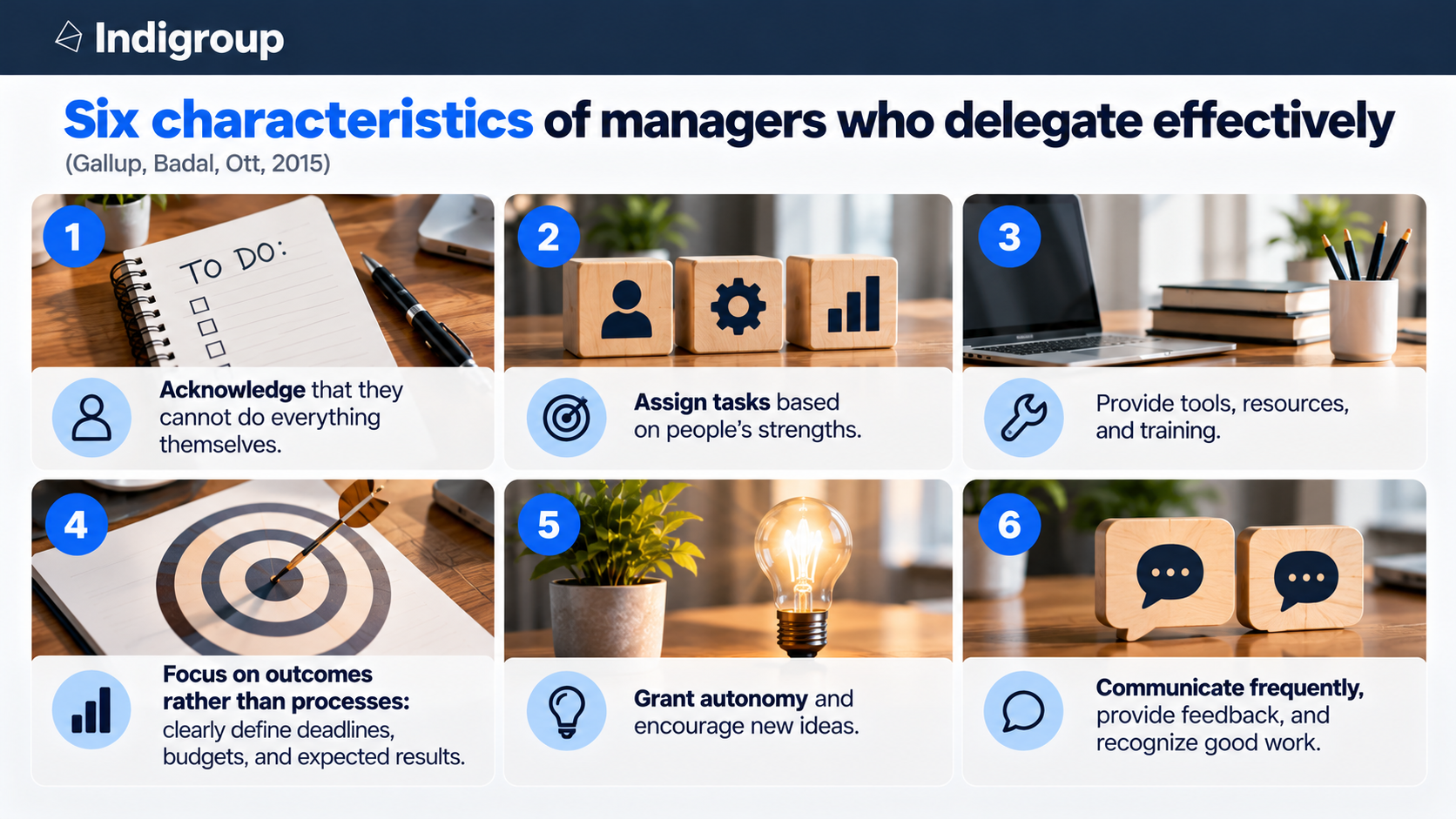
Gallup (Badal, Ott, 2015) identifies six characteristics of managers who delegate effectively:
- Acknowledge that they cannot do everything themselves;
- Assign tasks based on people’s strengths;
- Provide tools, resources, and training;
- Focus on outcomes rather than processes: clearly define deadlines, budgets, and expected results;
- Grant autonomy and encourage new ideas;
- Communicate frequently, provide feedback, and recognize good work.
Agreeing on the expected outcome involves three things: a clearly defined result, a deadline, and decision-making boundaries, such as the maximum amount an employee can spend or which decisions they can make without approval. Before delegating a recurring process, it is worth documenting it in a standard operating procedure (SOP) and explaining both the “what” and the “why,” because understanding the purpose allows the employee to handle unexpected situations independently.
Agree on a feedback schedule in advance: set check-in dates instead of constantly monitoring progress. Checking too frequently can turn into micromanagement and limit autonomy, which Gallup identifies as a characteristic of effective delegation.
And this is not just a leadership style. A meta-analysis of empowering leadership (Lee, Willis, Tian, Journal of Organizational Behavior, 2018; 105 samples) found a positive relationship with job performance, extra effort, and creativity. At the individual level, this relationship is explained by trust in the manager and psychological empowerment: an employee who is given decision-making authority by their manager may put in more effort than their role requires.
What Examples of Delegation in the Workplace Show What to Delegate and to Whom?
Good examples of delegation in the workplace demonstrate the transfer of an entire area of responsibility, rather than the assignment of individual actions. The principle is the same across different fields: the employee is given a task, authority, and clear boundaries, while the manager monitors results and deviations.
The head of the finance department delegates the preparation of the monthly report to a senior analyst, along with the authority to approve it and submit it to the board. The manager reviews only deviations from the budget, so they no longer need to go through every line.
In IT, a team leader delegates sprint planning to an experienced engineer. An even broader example is the CTO position at Venipak, whose responsibilities included budget preparation, selection and oversight of external vendors, and allocation of IT resources. This illustrates the delegation of IT management responsibilities to a single accountable manager.
A business owner delegates communication with suppliers only after the process has been documented in a procedure and an agreement has been reached on the maximum amount that can be negotiated without their involvement.
But what happens when the team lacks the necessary expertise? Brolis Sensor Technology was looking for a Senior Azure DevOps Engineer: this was the first DevOps position on the team and required a high degree of independence. In such cases, delegation can begin with hiring the right person, for example, through IT specialist recruitment.
What should not be delegated:
- Final personnel decisions: hiring, dismissal, and compensation;
- Choosing the strategic direction;
- Sensitive confidential matters;
- Final decisions in disciplinary and conflict situations.
Delegating to “just anyone” does not work. A lack of expertise can be addressed by hiring a specialist or manager: in the case of Eurokos, the in-house CTO position was new to the client, so Indigroup first defined the role’s responsibilities and only then carried out the executive search and recruitment.

Delegation: FAQ
What Are the Most Common Mistakes When Delegating Tasks?
Four common mistakes occur when delegating tasks: failing to define the expected outcome, not setting a deadline, assigning a task without granting decision-making authority, and checking too frequently, which can turn into micromanagement.
The Gallup study (Badal, Ott, 2015) describes managers who delegate poorly in precisely these terms: they micromanage, fail to set clear expectations, and centralize decision-making. As a result, employees may remain mere task executors, while managers bear the majority of the workload.
A single action may be enough to prevent each mistake. Ask the employee to repeat the task, expected outcome, and deadline in their own words: this can help identify gaps immediately. Agree on check-in dates in advance. Start with low-risk tasks to keep the cost of potential mistakes low.
When Should a Manager Hire a New Specialist Through a Recruitment Agency Instead of Delegating?
The decision depends on three factors: whether there is someone on the team with the necessary expertise, whether they have available capacity, and whether the task is recurring rather than a one-off.
When at least two of these factors are unfavorable, delegation may simply shift the problem to someone else, because assigning a task does not create the missing expertise. A one-off task can be handled by the manager or outsourced to a contractor, while a recurring area of responsibility may justify creating a new position.
A full recruitment process may include headhunting, referral-based searches, and broad public searches, while the replacement of an unsuccessful candidate depends on the guarantee terms of the contract. Indigroup has been providing these services in Lithuania, Latvia, and Estonia since 2010.
Delegation works when there is someone on the team who can be entrusted not only with an individual task but also with an entire area of responsibility. When no such person is available, the manager may remain responsible for carrying out tasks, leaving less time for management. This is where recruitment and selection can help. Indigroup works exclusively with full recruitment processes: headhunting, referral-based searches, and broad public searches.
If your team needs its first in-house CTO, an independent DevOps engineer, or a middle manager to whom you can delegate an entire area of responsibility, Indigroup can help you find a candidate in Lithuania, Latvia, or Estonia. Every recruitment process comes with a guarantee, so you can feel more confident when delegating, knowing that you are entrusting the area of responsibility to someone who has successfully passed the selection process.