
Workplace Climate: How to Recognize an Unhealthy Team Atmosphere and Improve It
2026 10 16Workplace climate is the psychological and social atmosphere within a team, which can determine whether employees want to stay with the company or quietly look for another employer. According to Gallup’s State of the Global Workplace 2026 report, global employee engagement fell to 20% in 2025, with most of the decline driven by a drop in managers’ own engagement.
The problem is that an unhealthy atmosphere is not always visible from the manager’s office. It can hide behind delayed reports, silence during meetings, and resignation requests citing “personal reasons.” By the time the employee turnover rate catches the finance department’s attention, the team may have already lost trust.
That is why it is worth knowing which early warning signs reveal a problem, how to measure workplace climate through a survey, and which three levers (manager behavior, communication, and team composition) can change it, as well as why recruitment becomes a tool for prevention rather than simply filling a vacancy.
What Are the Signs of an Unhealthy Workplace Climate?
Five recurring signs may indicate an unhealthy workplace climate: reluctance to go to work, ongoing conflicts and cliques, exhausting fatigue without a sense of satisfaction, withholding information from colleagues, and increasing employee turnover. Each of these signs may be temporary on its own, but together they may indicate that the psychological atmosphere is negatively affecting employees.
The difference between a healthy and an unhealthy team atmosphere can be seen in everyday situations:
- Sunday anxiety before the workweek begins, compared to calmly planning the week in a healthy team.
- Looking for someone to blame after a mistake, compared to open feedback in a healthy team.
- Information is withheld as a source of power, while in a healthy team it is shared freely.
- Conflicts build up within cliques, while in a healthy team they are resolved openly.
- New employees leave within the first few months, while in a healthy team they are more likely to stay after their probationary period.
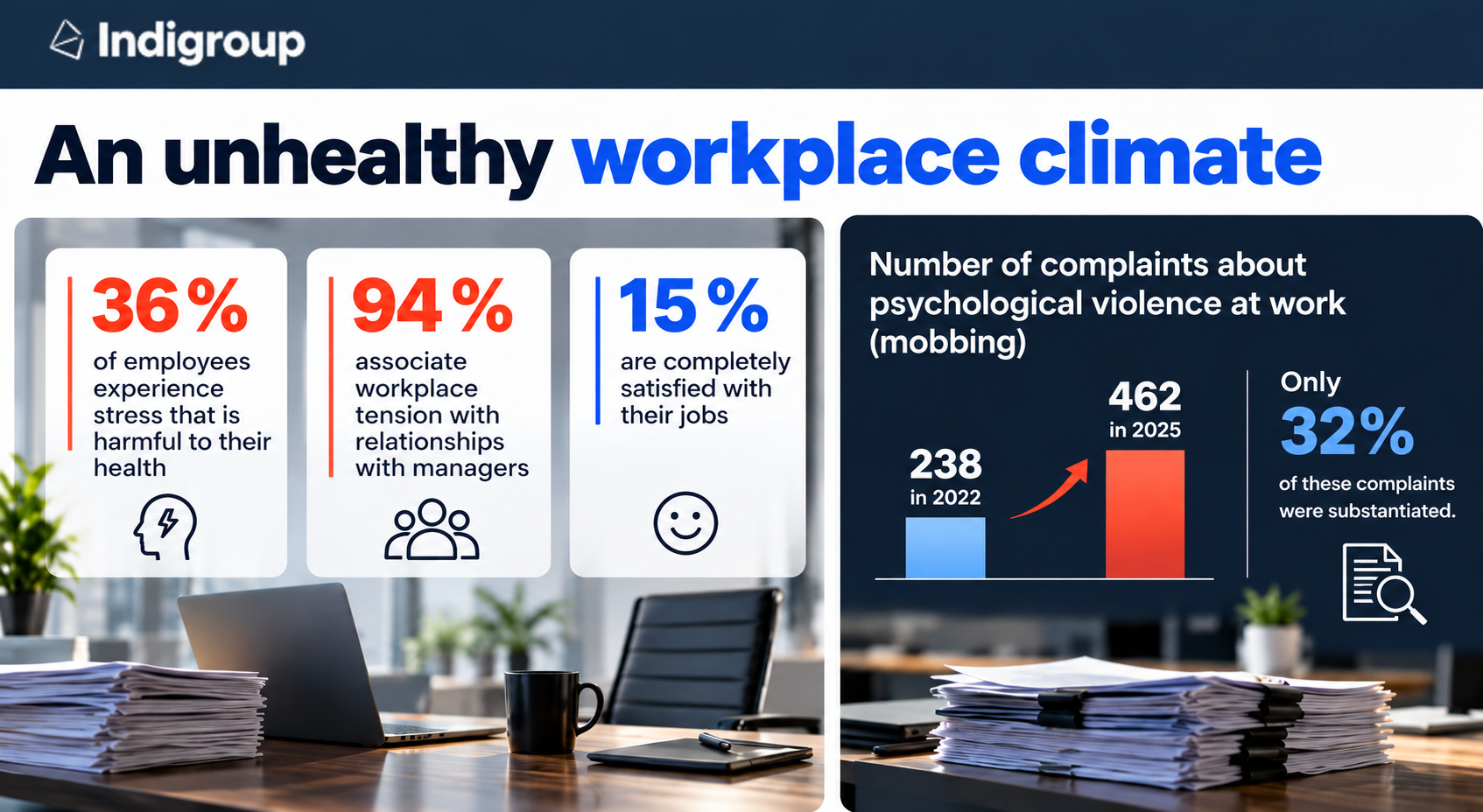
This is also a relevant issue in Lithuania. A survey conducted in the country found that 36% of employees experience stress that is harmful to their health, 94% associate workplace tension with relationships with managers, and only 15% are completely satisfied with their jobs.
A similar trend has also been recorded by the State Labour Inspectorate: the number of complaints about psychological violence in the workplace (mobbing) increased from 238 in 2022 to 462 in 2025. Only 32% of these complaints were substantiated, which the Inspectorate attributes to employees’ lack of understanding of what constitutes psychological violence.
In other words, the workplace climate can deteriorate unnoticed, and employees may find it difficult to distinguish between normal workplace tension and a systemic problem. The consequences can go beyond health: a poor psychological climate within an organization can increase employee turnover and the costs of repeated recruitment.
Why Does Workplace Climate Affect Employee Turnover and Employer Attractiveness?
A poor workplace climate can cause chronic stress and burnout, reduce productivity, and increase voluntary employee turnover, while every employee who leaves can result in additional recruitment costs.
The chain of events begins with stress. Constant tension within a team can lead to mistakes, sick leave, and eventually resignation. According to the WHO and ILO, depression and anxiety result in approximately 12 billion lost working days each year, costing the global economy nearly US$1 trillion in lost productivity. For the first time, the WHO recommends training for managers to help reduce psychosocial risks in the workplace.
Next comes the cost of employee turnover. According to Gallup’s conservative estimate, replacing an employee costs between half and twice their annual salary. Among employees who voluntarily left their jobs, 52% say their manager could have prevented them from leaving, while 51% had not had a conversation about their job satisfaction in the three months before their departure (US data, Gallup study). This suggests that some departures could have been prevented.
Candidates can assess the workplace climate even before signing a contract. They may consider employee turnover rates, reviews from former employees, and their first impression during an interview with their prospective manager. Meanwhile, passive candidates reached through headhunting typically already have jobs and may turn down an offer from a company with a poor reputation.
This makes the workplace climate part of the employer brand: employer climate assessments (“Deem”) and employer branding studies examine related phenomena from two perspectives – those of current employees and external candidates. The same factors can influence both assessments.
How Can You Improve Workplace Climate Through Leadership, Communication, and Team Composition?
Improving the workplace climate can begin with an assessment, namely a workplace climate survey, followed by a focus on three main factors: manager behavior, regular communication, and selecting the right people for the team.
Slogans about a “friendly team” will not solve the problem when it stems from manager behavior. The importance of managers is also highlighted in Gallup’s State of the Global Workplace report: manager engagement fell from 27% to 22% over the course of a year, and this decline was the main driver of the overall decrease in global employee engagement.
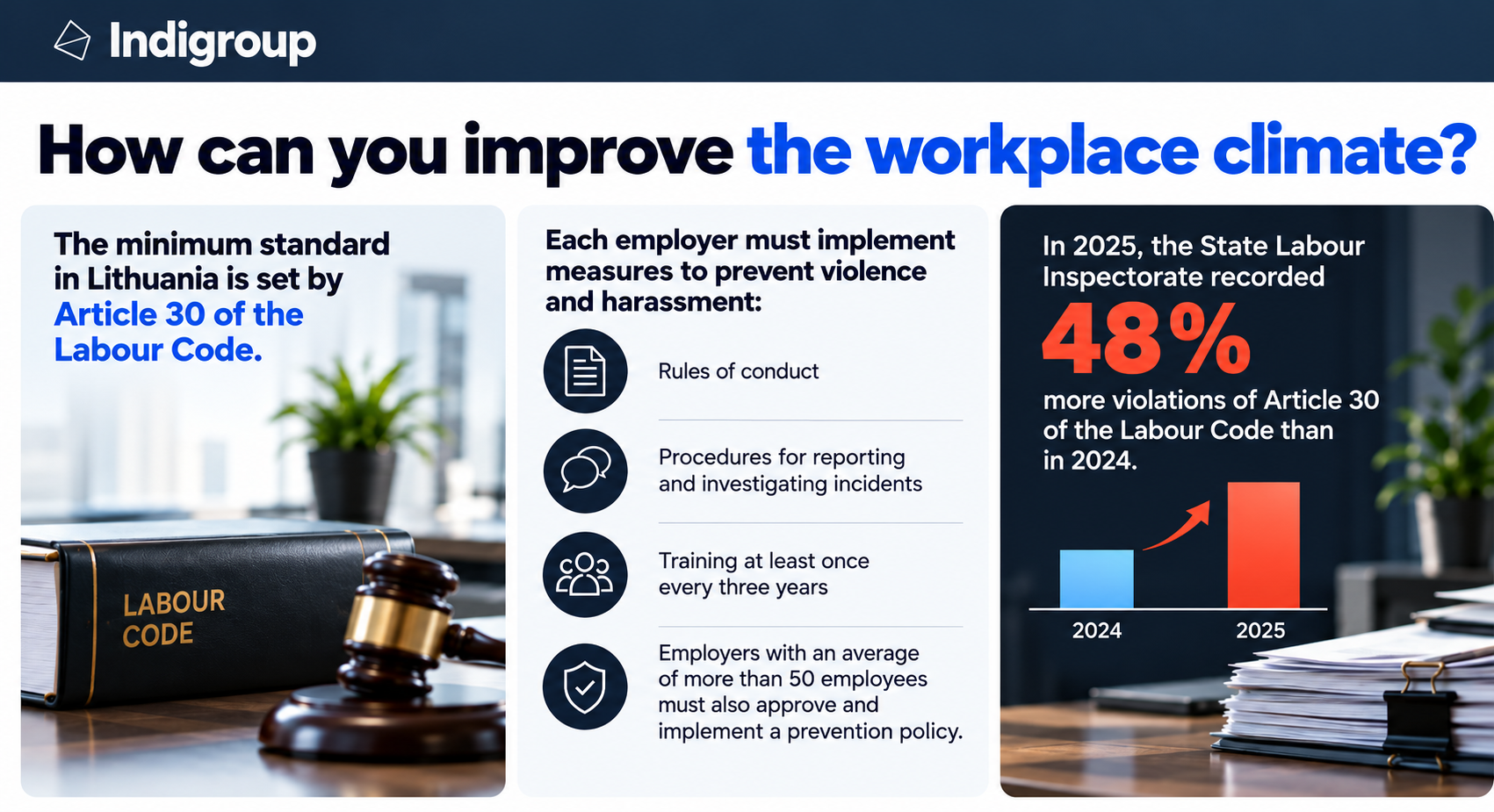
The minimum standard in Lithuania is established by Article 30 of the Labour Code and its implementing legislation: every employer must implement measures to prevent violence and harassment (rules of conduct, procedures for reporting and investigating incidents, and training at least once every three years), while employers with an average of more than 50 employees must also approve and implement a prevention policy. Nevertheless, in 2025, the State Labour Inspectorate recorded 48% more violations of Article 30 of the Labour Code than in 2024.
How to Conduct a Workplace Climate Survey in an Organization?
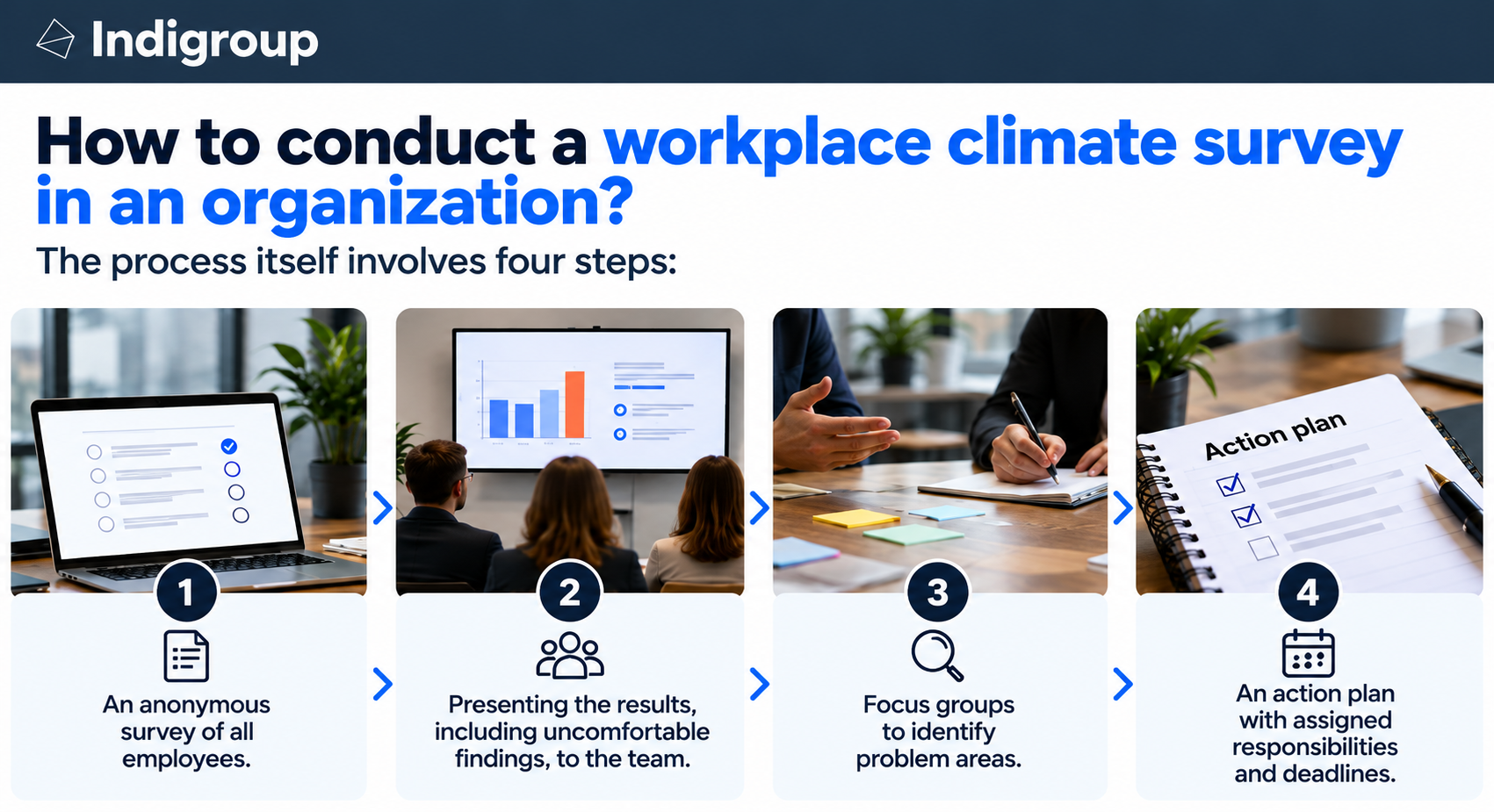
A workplace climate survey can be conducted through an anonymous employee questionnaire assessing managerial support, workload, communication, and trust. The results are then discussed in focus groups and used to develop an action plan.
The three concepts differ in their assessment objectives. A psychological climate survey assesses employees’ experiences and relationships within the organization. Employer climate assessment, based on the Deem methodology used in the Baltic countries, evaluates the organization as an employer from candidates’ perspectives. Psychosocial risk assessment, on the other hand, is mandatory and subject to inspection by the State Labour Inspectorate: in 2025, 87.4% of inspected entities had carried it out.
The process itself involves four steps:
- An anonymous survey of all employees.
- Presenting the results, including uncomfortable findings, to the team.
- Focus groups to identify problem areas.
- An action plan with assigned responsibilities and deadlines.
A survey without discussion and follow-up actions can undermine trust: employees may get the impression that their opinions make no difference.
What Role Does a Manager Play in Shaping the Workplace Climate?
A manager is one of the most important factors influencing the workplace climate: according to Gallup, managers account for at least 70% of the variance in employee engagement across business units.
What can a manager do this week? One effective habit is simple. Spending 15–30 minutes at least once a week providing each employee with meaningful feedback (recognition, discussing goals, and focusing on strengths) is associated with nearly three times the proportion of engaged employees: 7 in 10 compared to 1 in 4. However, only 16% of employees say their most recent conversation with their manager was extremely meaningful, according to Gallup’s Span of Control study.
The second factor is psychological safety – a concept developed by Harvard researcher Amy Edmondson. Google’s Project Aristotle, which studied 180 teams, found that psychological safety is the most important factor in team effectiveness. Managers can strengthen it through three actions: framing work as a learning opportunity, acknowledging their own fallibility, and asking questions more often rather than making statements.
However, according to Gallup, in 82% of cases, companies fail to select candidates with high management potential for managerial positions: employees are often promoted based on their success in previous roles or their length of service. Therefore, executive search and recruitment can be one of the most important ways to improve the workplace climate.
How Do Team Composition and Recruitment Affect the Workplace Climate?
Team composition affects the workplace climate through value alignment: a new employee whose values do not align with those of the team may leave during the probationary period or create tension within the team. This makes recruitment one of the preventive measures for improving the workplace climate.
In the Drogas CFO recruitment process, candidates were assessed in three stages: professional competence, cultural fit, and personal qualities using a standardized executive assessment methodology. In the Tele2 Front-End Developer recruitment process, the selected candidate’s values, according to the project manager, fully aligned with the employer’s values, and such alignment can increase loyalty. At Miles Lithuania, all candidates hired over a 24-month period successfully completed their probationary periods.
Employers should consider including competencies, behavior in conflict situations, and attitudes toward feedback in their recruitment criteria. The team atmosphere should be described honestly to candidates so that their expectations align with reality.
Workplace Climate: FAQ
How Often Should an Organization Conduct a Workplace Climate Survey?
It is recommended to conduct a workplace climate survey once a year, with additional surveys following major changes, such as leadership turnover, reorganization, or a sudden increase in employee turnover.
An annual survey allows organizations to compare indicators using the same questions and monitor whether workplace climate improvement measures are producing results. Plan to discuss the findings with employees as part of the survey process, as conducting a survey without providing feedback can undermine trust in management.
Is It Worth Assessing the Workplace Climate Before Starting the Recruitment Process?
Yes, it is worth assessing the workplace climate before starting the recruitment process, because a new employee who joins an unhealthy team may leave during the probationary period, making it necessary to repeat the recruitment process.
Recruitment agencies that use the Deem employer climate assessment methodology can evaluate the workplace atmosphere before developing the value proposition for the position. This allows candidates to receive more realistic information about the team. If the recruitment guarantee provides for it, an unsuccessful candidate is replaced, but this does not address the underlying reason why employees leave.
Does Workplace Climate Also Include Physical Working Conditions, Temperature, and Humidity?
In the context of human resource management, workplace climate generally refers to the psychological and social atmosphere within a team. The physical workplace climate (temperature, humidity, and air movement) is a separate area of occupational health and safety regulated by Lithuanian hygiene standards.
Both factors affect employees’ ability to work, but they are assessed differently: the psychological climate within an organization can be evaluated through anonymous surveys and interviews, while the physical workplace climate is measured using instruments in accordance with the requirements applicable to workplaces.
Workplace climate is shaped not only by surveys or change programs, but also by the people entrusted with leading others. According to Gallup, managers account for at least 70% of the variance in employee engagement across business units, while in 82% of cases, companies fail to select candidates with high management potential for managerial positions. Therefore, selecting the right managers can become one of the most important ways to improve the team atmosphere.
Indigroup has been operating in the recruitment and selection industry since 2010, assessing candidates based on three criteria: professional competence, cultural fit, and personal qualities. The aim is to select a manager who meets not only the requirements of the position but also the team’s actual culture. If you are planning to strengthen your team by filling leadership positions, start with executive search and recruitment: let’s discuss what kind of person your team really needs.